
WEEK 2 | Daniel 1:3-16
Day 1 Part I Central Passage Father, open my eyes to see the truth in Your Word that I may know and love you more deeply.
Then the king commanded Ashpenaz, his chief eunuch, to bring some of the people of Israel, both of the royal family and of the nobility, 4 youths without blemish, of good appearance and skillful in all wisdom, endowed with knowledge, understanding learning, and competent to stand in the king's palace, and to teach them the literature and language of the Chaldeans. 5 The king assigned them a daily portion of the food that the king ate, and of the wine that he drank. They were to be educated for three years, and at the end of that time they were to stand before the king. 6 Among these were Daniel, Hananiah, Mishael, and Azariah of the tribe of Judah. 7 And the chief of the eunuchs gave them names: Daniel he called Belteshazzar, Hananiah he called Shadrach, Mishael he called Meshach, and Azariah he called Abednego. — Daniel 1:3-7 ESV
OBSERVE DETAILS
Ask and answer simple w-questions v when? where? who? what? how?
1. The KING
Using verses 1-4, sum up what the king commanded Ashpenaz, the chief eunuch to do.
What did he command for them to consume for their minds? (vs 4-5)
What specifically did he assign for the chosen youth to consume for their bodies? (v5)
How long did he grant for their education?
Who would test them?
2. ASHPENAZ
What is Ashpenaz’s title?
Using verses 1-7, write a brief job description for the chief eunuch.
What type of education would the chief eunuch need to possess himself?
What is your estimation of his authority?
3. The YOUTHS of the Tribe of Judah
From what types of families are these youths?
What other qualifications did they need to possess for Ashpenaz to have chosen them?
OBSERVE DICTION
Ask v Which words/phrases might provide clues to the author’s message? What do they literally mean?
Ex. youths > The Hebrew term yeledim is used of young men aged 15 to 20.
Ex. gave/called > set or appointed. When we observe the diction of 1:8, we shall see this same word engaged in a wordplay.
Daniel > God is Judge or God is my Judge. > Belteshazzar, which likely means “May Bel protect his life.”
Hananiah > Yahweh is gracious. > Shadrach, connected to Aku, the Babylonian moon god
Mishael > Who is what God is? > Meshach, maybe “Who is what Aku is?”
Azariah > Yahweh has helped > Abednego, possibly “Servant of the god Nebo” (god of wisdom)
Note the last two letters of the youths’ given names. These suffixes signify theophoric Hebrew names that honor the One True God. The suffix -elconnects to Elohim, the general word for God. The suffix -ah connects to Yahweh God’s covenant name.
Historical Context – Education: Daniel and his friends were to be educated in a form of Akkadian language. It was written in cuneiform and typically engraved on clay tablets with a stylus. Due to their anticipated service in the Babylonian government, they were to be taught to read their historical and legal documents, their texts of the science of astrology, and their religious texts of magic, sorcery, omens, and the occult. Although the Mosaic Law forbade all occultic practices, it did not forbid the study of pagan religious practices. Food: In Babylon, the court practice was that idols were offered fine food first; then that same food was served to the king and his court. The Law prohibited consuming what was offered to an idol (Ex 34:15; Num 25:2; Dan 5:1-4). And likely some of this food was also “unclean” in some way (see dietary laws in Leviticus 7 and 11).
INTERPRET
Ask: Why did the author choose to include these details, use these words, & make any figurative comparisons?
Big Q -- What does Daniel want readers to see about Nebuchadnezzar’s strategic purpose for his commands?
4. Before we get to that Big Q, let’s consider the Babylonian Empire’s purposes for onboarding their newly acquired slaves from conquered countries under these parameters. Jot your thoughts next to each detail.
Why “royal” and “nobility”?
Why “youth”?
Why “without blemish” (meaning with no physical defect)?
Why handsome?
Why intelligent?
Why competent for service in the court?
Why the king’s food?
Why the name changes? Consider why parents are the “namers” of their children.
Why Babylonian language, history, law, sciences, and religion?
Why three years?
5. What does Daniel want the readers to see about Nebuchadnezzar’s strategic purpose for his commands?
Praise God that your identity is in Christ. Ask Him to guard your heart so you can stand firm in His Word.
Day 2 Part II Central Passage Father, open my eyes to see the truth in Your Word that I may know and love you more deeply.
But Daniel resolved that he would not defile himself with the king's food, or with the wine that he drank. Therefore he asked the chief of the eunuchs to allow him not to defile himself. 9 And God gave Daniel favor and compassion in the sight of the chief of the eunuchs, 10 and the chief of the eunuchs said to Daniel, “I fear my lord the king, who assigned your food and your drink; for why should he see that you were in worse condition than the youths who are of your own age? So you would endanger my head with the king.” 11 Then Daniel said to the steward whom the chief of the eunuchs had assigned over Daniel, Hananiah, Mishael, and Azariah, 12 “Test your servants for ten days; let us be given vegetables to eat and water to drink. 13 Then let our appearance and the appearance of the youths who eat the king's food be observed by you, and deal with your servants according to what you see.” 14 So he listened to them in this matter, and tested them for ten days. 15 At the end of ten days it was seen that they were better in appearance and fatter in flesh than all the youths who ate the king's food. 16 So the steward took away their food and the wine they were to drink, and gave them vegetables. — Daniel 1:8-16 ESV
OBSERVE PLOT SEQUENCE
Beginning with the pivoting word, “But” the story’s rising action ramps up. Show that by writing the gist of the how one action leads to the next which leads to the next....until we reach the climax in verse 15.
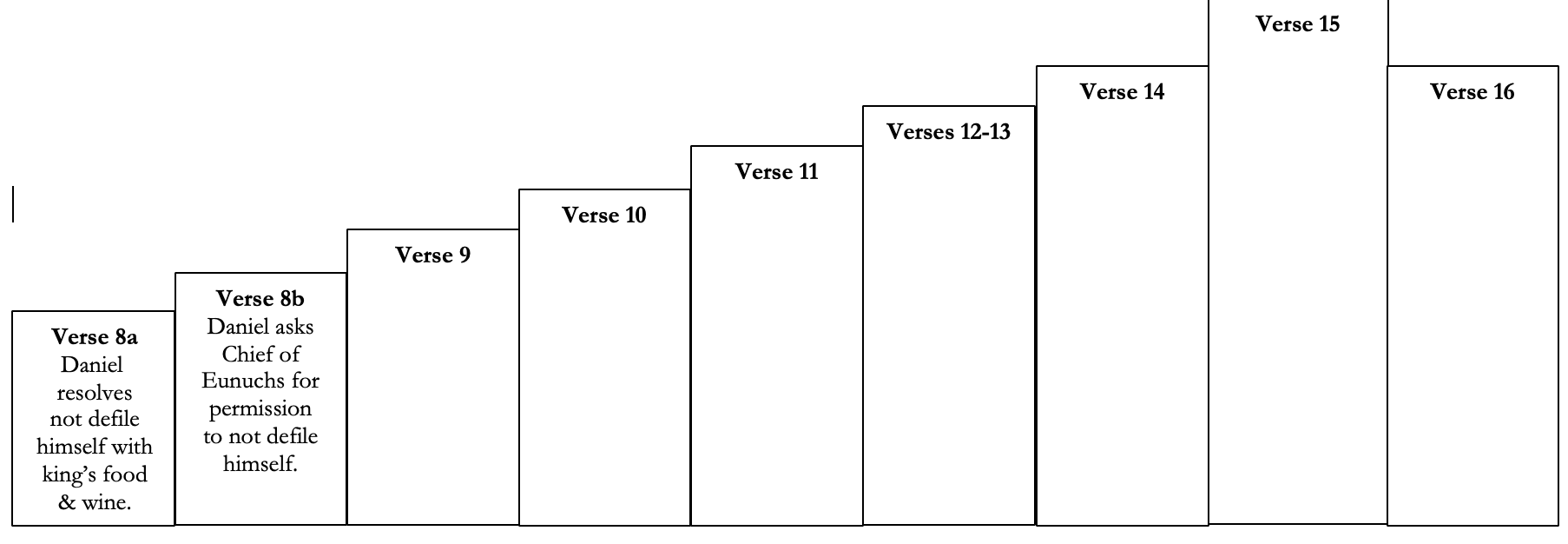
OBSERVE DICTION
Ask: Which words/phrases might provide clues to the author’s message? What do they literally mean?
Ex. resolve > intend. Literally it meant that Daniel “set his heart on.”
It is the same Hebrew word translated as “gave” in verse 7. Think about what Ashpenaz “set” on Daniel.
Ex. favor & compassion > hesed
Usually hesed is translated as “loyal love,” and it can be used of God’s love toward those with whom He has a covenant. Consider how in Daniel’s situation God’s loyal love “looks like” giving him favor & compassion.
Ex. vegetables > zeroa, the Hebrew word for food that grows out of the ground; this includes grains as well.
INTERPRET
Ask: Why did the author choose to include these details, use these words, & make any figurative comparisons?
6. What characterizes Daniel’s responses to Nebuchadnezzar’s strategic purposes for him?
Consider Daniel’s inward response and outward responses to first Ashpenaz and then his steward.
7. What revelation from God did Daniel act upon?
8. In Week 1, we read the Ruler of the Universe gave Jehoiakim and the Temple vessels into Nebuchadnezzar’s hands (Dan 1:2). In the Babylonian mindset, this meant Israel’s God was defeated. The implications on the lives of the sons of Jerusalem -- Daniel, Hananiah, Mishael, and Azariah – would seem to support the Babylonian mindset.
Reflect on all these sons would have seen, heard, smelt, and felt as they were besieged and seized from their families and then forced to walk from Jerusalem to Babylon (@700 miles).
Reflect on the future they had likely imagined for themselves as men of royal and noble families in Jerusalem.
How does reflecting on these youths’ losses impact your appreciation for their response to God and human authority?
9. This week we learned that the Ruler of the Universe gave Daniel favor and compassion after he resolved to obey the revealed Word of God. Review verses 1:12-16.
What was “seen” that challenged the Babylonian mindset that the God of Daniel, Hananiah, Mishael, and Azariah was defeated?
Beyond this physical reality, what else might have been “seen” by the conquering human authorities...? by the defeated other eunuchs...? by Daniel, Hananiah, Mishael, and Azariah themselves?
Praise God that your identity is in Christ. Ask Him to guard your heart so you can stand firm in His Word.
Day 3 Deeper Daniel Father, open my eyes to see the truth in Your Word that I may know and love you more deeply.
For these next three days, we are going to practice the spiritual discipline of surrendering to God’s Word, trusting its Author’s love for us and His desire that we would obey Him out of love.
1. Daniel resolved to obey; God gave favor and compassion that allowed Daniel and his friends to obey and remain in the program.
Reflect on how Daniel “set his heart on” obeying God’s commands about what he could not consume.
Reflect on God’s heart for His people that led Him to give such commands.
What did He desire for them?
2. When Jesus was asked what was the most important law, He cited the one that summed up ALL the laws:
Love the Lord your God with all your heart and with all your soul and with all your mind and with all your strength. Mark 12:30 NLT
Reflect on Jesus’ heart for you that led Him to give this answer.
What does He desire for you?
Find a quiet place to pray. Worship God with your body by kneeling or laying prostrate before God or walking the floor or sitting still in focus. Worship Him with your voice by praying out loud. Pray about surrendering your desires for your relationship with Him to His will. Yield all He has given you to love Him with into His hands.
Day 4 Deeper Daniel Father, open my eyes to see the truth in Your Word that I may know and love you more deeply.
Therefore I urge you, brothers and sisters, by the mercies of God, to present your bodies as a living and holy sacrifice, acceptable to God, which is your spiritual service of worship. 2 And do not be conformed to this world, but be transformed by the renewing of your mind, so that you may prove what the will of God is, that which is good and acceptable and perfect. Romans 12:1-2 NASB
Meditate carefully on these verses.
Reflect on how God is loving you by giving you this Word.
What does He desire for you?
Find a quiet place to pray. Worship God with your body by kneeling or laying prostrate before God or walking the floor or sitting still in focus. Worship Him with your voice by praying out loud. Pray through this verse surrendering your desires for your love relationship to His will. Yield all He has given you to love Him with into His hands.
Day 5 Deeper Daniel Father, open my eyes to see the truth in Your Word that I may know and love you more deeply.
Therefore, if you have been raised with Christ, keep seeking the things that are above, where Christ is, seated at the right hand of God. 2 Set your minds on the things that are above, not on the things that are on earth. 3 For you have died, and your life is hidden with Christ in God. 4 When Christ, who is our life, is revealed, then you also will be revealed with Him in glory. Colossians 3:1-3
Meditate carefully on these verses.
Reflect on how God is loving you by giving you this Word.
What does He desire for you?
Find a quiet place to pray. Worship God with your body by kneeling or laying prostrate before God or walking the floor or sitting still in focus. Worship Him with your voice by praying out loud. Pray through this verse surrendering your desires for your love relationship to His will. Yield all He has given you to love Him with into His hands.
Group Reflection Faithful in Exile
Hypotheticals & Rhetoricals to Get Us Strategizing to Stand Firm Together
In light of what we learned about Daniel’s resolve, how would you prepare your children to live apart from you as obedient Christ followers if you knew they were soon to be taken into captivity in a pagan land? What would you most prioritize with your limited time?
In light of how we saw Daniel and Hananiah and Mishael and Azariah together standing firm on the Word of God, how might you prepare all the youth of your God-Centered community to live in captivity?
Would you be able to prepare your children if you yourself were not devoted to God, devoted in love for Him and for His Word?
Would you be able to prepare all the youth of your God-Centered community if you yourself were not in community with like-minded followers of Christ?
1. Discuss with your group why I set up these hypothetical questions. The passage below should be of help.
For the grace of God has appeared, bringing salvation to all people, 12 instructing us to deny ungodliness and worldly desires and to live sensibly, righteously, and in a godly manner in the present age, 13 looking for the blessed hope and the appearing of the glory of our great God and Savior, Christ Jesus, 14 who gave Himself for us to redeem us from every lawless deed, and to purify for Himself a people for His own possession, eager for good deeds. Titus 2:11-14
2. Get practical.
In light of today’s lesson, what should you put on your calendar that will prepare YOU and US to live faithfully in this world but not of this world? Think daily and weekly.
Are you willing to set those Godward Rhythms on your calendar this week and then share with your group how well you remained committed to what you appointed?
Prayer
Pray through Titus 2:11-14 for one another and for you all as a group.
Pray for our elders who serve as overseers of the teaching of the Word in our church that they would stand firm in the Word.
Pray for our parents who are raising their families in a world that seeks to reprogram their children to its standards instead of God’s.
God’s joy & strength to you!