
Week 10: Our God Is Able to Deliver Us
WEEK 10 | Daniel 3:8-18
Day 1 Central Passage #1 Father, open my eyes to see the truth in Your Word that I may know and love you more deeply.
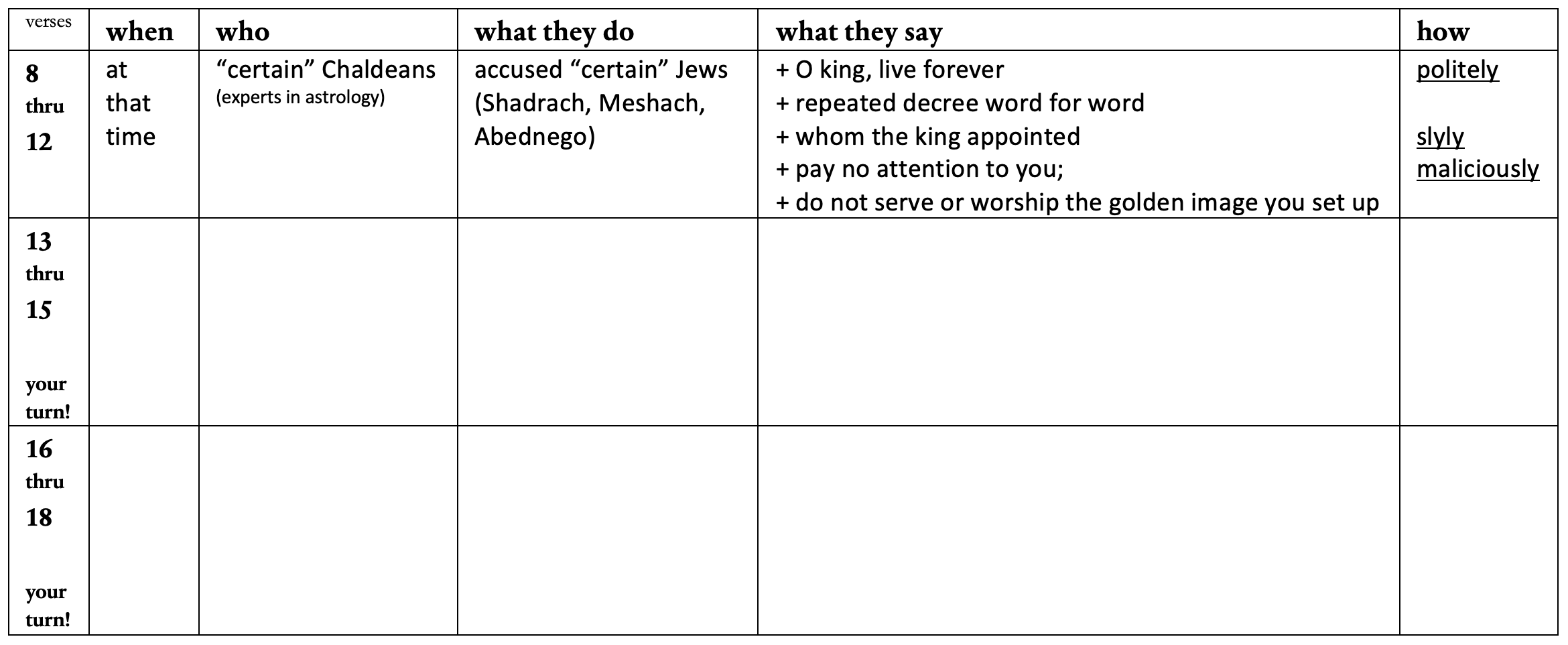
Therefore at that time certain Chaldeans came forward and maliciously accused the Jews. 9 They declared to King Nebuchadnezzar, “O king, live forever! 10 You, O king, have made a decree, that every man who hears the sound of the horn, pipe, lyre, trigon, harp, bagpipe, and every kind of music, shall fall down and worship the golden image. 11 And whoever does not fall down and worship shall be cast into a burning fiery furnace. 12 There are certain Jews whom you have appointed over the affairs of the province of Babylon: Shadrach, Meshach, and Abednego. These men, O king, pay no attention to you; they do not serve your gods or worship the golden image that you have set up.”
13 Then Nebuchadnezzar in furious rage commanded that Shadrach, Meshach, and Abednego be brought. So they brought these men before the king. 14 Nebuchadnezzar answered and said to them, “Is it true, O Shadrach, Meshach, and Abednego, that you do not serve my gods or worship the golden image that I have set up? 15 Now if you are ready when you hear the sound of the horn, pipe, lyre, trigon, harp, bagpipe, and every kind of music, to fall down and worship the image that I have made, well and good. But if you do not worship, you shall immediately be cast into a burning fiery furnace. And who is the god who will deliver you out of my hands?”
16 Shadrach, Meshach, and Abednego answered and said to the king, “O Nebuchadnezzar, we have no need to answer you in this matter. 17 If this be so, our God whom we serve is able to deliver us from the burning fiery furnace, and he will deliver us out of your hand, O king. 18 But if not, be it known to you, O king, that we will not serve your gods or worship the golden image that you have set up.” — Daniel 3:8-18 ESV
OBSERVE DETAILS
Ask and answer simple w-questions: when? where? who? what? how?
OBSERVE DICTION
Ask: Which words/phrases might provide clues to the author’s message? What do they literally mean?
Ex. maliciously accused > literally “eat their pieces,” meaning to slander a person. This word is also used of beasts who devour. See Daniel 4:33; 6:24; 7:5, 7, 19, 23.
Ex. serve > to serve a deity is to worship a deity. So the Chaldeans accuse the three Hebrews of not worshiping Nebuchadnezzar’s gods (v12); See also verses 17-18.
Death and life are in the power of the tongue. And those who love it will eat its fruit. — Proverbs 18:21 NASB
The good man out of the good treasure of his heart brings forth what is good; and the evil man out of the evil treasure brings forth what is evil; for his mouth speaks from that which fills his heart. Luke 6:45 NASB
Historical Context – In today’s text, the Chaldeans call the King’s attention to “certain Jews” who do not comply with the King’s command. This definitely speaks to their prejudice towards a people commanded to follow the laws of the God of heaven alone. The book of Esther reveals this same attitude toward the Jews. Mordecai, a Jew living in Persia after the exile, refused to bow or pay homage to Haman after his promotion by the King. Haman says to the King, “There is a certain people...their laws are different from those of all other people and they do not observe the king’s laws.” He then proposed that King Ahasuerus destroy all the Jews in his land. A plan is put in action, but God thwarts Haman’s plan and he eats the fruit of his treasure and tongue.
INTERPRET
Ask: Why did the author choose to include these details, use these words, & make any figurative comparisons?
1. How would you characterize the treasure and tongue of these certain Chaldeans?
2. How would you characterize the treasure and tongue of Nebuchadnezzar? Consider most especially what the King’s last words in verse 15 reveal.
3. How would you characterize the treasure and tongue of these certain Jews named Hananiah, Mishael, and Azariah? Consider most especially what their last words in verse 18 reveal.
Prayer – Unlike these Chaldeans and Nebuchadnezzar, Hananiah, Mishael, and Azariah do not fear loss of any kind because they have Whom they desire and serve. Pray that you and all you influence would not fear loss, even loss of life, because God is the strength of our heart and our forever portion (Psalm 73:25-26).
Day 2 Central Passage #2 Father, open my eyes to see the truth in Your Word that I may know and love you more deeply.
Now who is there to harm you if you are zealous for what is good? 14 But even if you should suffer for righteousness' sake, you will be blessed. Have no fear of them, nor be troubled, 15 but in your hearts honor Christ the Lord as holy, always being prepared to make a defense to anyone who asks you for a reason for the hope that is in you; yet do it with gentleness and respect, 16 having a good conscience, so that, when you are slandered, those who revile your good behavior in Christ may be put to shame. 17 For it is better to suffer for doing good, if that should be God's will, than for doing evil. — 1 Peter 3:13-17 ESV
1. Make a list of all whom you should not fear but do fear*.
*How do you know whom you fear more than God? These persons “trouble” you causing turbulent emotions, perhaps because they slander you or revile your good behavior as Peter shares here. You want to say you do not actually fear them; however, you realize you give more honor to them than to God because they preoccupy your thoughts and dictate your actions.
2. Peter describes a person who honors Christ in two ways. This person --
o is prepared to make a defense of faith to ANYONE (a defense using biblical truth)
o has a good conscience (a defense through purely motivated deeds)
Consider our story in Daniel and Peter’s admonition.
How should you be praying for the unbelievers your triad/quad has placed on your prayer wall?
How should you be praying for yourselves?
3. Explain Peter’s seeming contradiction between “who is there to harm you....?” and “even if you should suffer....” to a young friend who is being tested and looking to honor the Lord.
Do you have a story where you experienced Jesus when you suffered for righteousness’ sake? Jot a few notes about the details of that story that might help a young friend whose loyalty to God is being tested
*In Deeper Daniel Days 4-5, you will write a story of God’s faithfulness to you. This may be the story you wish to develop.
Prayer – Praise God that there is no one who can harm you if you are zealous for God. You may suffer on earth, but God will one day vindicate you and reward you. Confess wherever your fear of man is greater than your fear of God. Pray for your triad/quad as witnesses of the God who is able to deliver and pray for your unbelieving family members or friends that He would deliver them (See Q2 arrow 2.).
Day 3 Deeper Daniel Father, open my eyes to see the truth in Your Word that I may know and love you more deeply.
Jesus said of Satan, “He was a murderer from the beginning, and does not stand in the truth, because there is no truth in Him. Whenever he speaks a lie, he speaks from his own nature; for he is a liar and the father of lies.” John 8:44
Before Satan fell, he was both wise and beautiful, but his pride corrupted him (Ezekiel 28:17a; 1 Timothy 3:6). Jesus calls Satan the father of lies because he was the first to lie. He slandered the God of heaven (Ezekiel 28:16a) and his lies persuaded one-third of the angels to revolt against God’s authority (Revelation 12:4). God “destroyed” him by removing him from his highest position as the covering cherub or guardian of God’s throne. Satan also initiated the fall of man when he lied to Eve about the character of God, and when Adam ate of the fruit, sin and death entered the world. (Genesis 3:1-6).
The point is God Himself has been slandered. All devoted to Him will be likewise suffer persecution (Matthew 5:3-11).
One of Satan’s strategies is to attack the mind of those who do not know God and those who do know God.
Why the Mind?
o You are created in the image of God. Your mind is where God communicates truth and His will to you.
o Our thoughts are hidden, so the mind is a perfect place for a secret conversation. Remember Satan masquerades as an angel of light (2 Cor. 11:13-14).
Satan’s Lies
o Maybe you misunderstood what God said.
o Maybe God is not all good. If He is then why?...
o God is holding out on you. You deserve better.
o You are too strong to sin. You can withstand that temptation
o If He really loved you, then….
o You are more important than the others.
o You are good. You are the victim.
o You can be like God.
o YOU should be served (worshiped).
o God’s demands too much from you.
o You will escape the consequences of disobeying God (or those consequences will be worth _____).
One way Satan attacks believers is to accuse us in our minds (Revelation 12:10).
These accusations may hold some truth, but they will also carry a lie that contradicts Scripture. Example: “You lost your temper again. You will never change. You cannot be used of God.” You may have lost your temper again, but God can change you and use you, just as we have seen Him do in so many lives in the Bible. The truth is that His Word tells those stories because it is His will to change us (Philippians 2:13).
Why Does Satan Lie?
To make you ignorant of God’s will. His desire is that you will not glorify God. Glorifying God is your only true joy because this is what you were created to do.
In light of learning about the lies and accusations of Satan....
v pray for your personal prayer request and the personal requests of those in your triad/quad.
v pray for the unbelieving family members and friends of those in your triad/quad.
v pray for your group’s global missionary.
In lesson 11, we will learn more about how to stand firm against our great enemy the devil (1 Peter 5:8-9).
Day 4 Deeper Daniel Father, open my eyes to see the truth in Your Word that I may know and love you more deeply.
Adam and Eve did not experience suffering and pain until after sin corrupted their minds, hearts, and bodies and the world. The enemy’s intention for suffering is that we become impatient and revile God. The book of Job is considered to be the oldest book in the Bible, and interestingly it is about a man’s journey through suffering. When Job lost everything, his wife told him to “Curse God and die!” Had Job yielded to that temptation, he would not have a story of God to tell! Of Job, James writes, “We count those blessed who endured. You have heard of the endurance of Job and have seen the outcome of the Lord's dealings, that the Lord is full of compassion and is merciful” (5:11).
Hananiah, Mishael, and Azariah, said, “... our God whom we serve is able to deliver us from the burning fiery furnace, and he will deliver us out of your hand, O king. But if not, be it known to you, O king, that we will not serve your gods or worship the golden image that you have set up.” We can stand firm against the enemy when we testify of God’s faithfulness during our trials and after our trials. During his trial Job said, “But He knows the way I take; when He has tried me, I shall come forth as gold” (23:10). We have been reading of Joseph in some of our Deeper Daniel lessons. After his trial, Joseph said of his brothers (and the enemy), “As for you, you meant evil against me, but God meant it for good, to bring it about that many people should be kept alive, as they are today (Genesis 50:20).
Do you have a story to share of experiencing God’s faithfulness to you?
1. In previous Deeper Daniel lessons, we compared Daniel and Joseph’s journeys and saw that God has similar processes for conforming us to Christ for our good and the good of others we influence. In today’s lesson, more processes have been included. Highlight or underline one or more of those that you could develop into a story of God’s faithfulness to you in a particular season of life. Even if you are still in the middle of a process, go ahead and mark it.
early influences, events (childhood through teens)
call to salvation/regeneration.
need/hunger for God’s Word & prayer
health issues
move
loss (person, reputation, status, innocence)
training/equipping/books/curriculum/higher education
employment/career
models, mentors, teachers, Christ-following friends
sin revealed to self, sin revealed to others, experiencing consequences of sin
recovery, pursuing healing, season of rest
spiritual warfare attack
injustice
people who recognize, identify, affirm your gifts/strengths/growth
ministry assignments
leadership position
burden for others, perhaps specific group of people
crisis events James 1:2-4
people who wound us
family needs
confusion of the role women have in marriage, church, world
season of isolation -- Illness, burnout, move, loss of job or ministry
desperate need for the fullness of the Holy Spirit
season of waiting and waiting and waiting
ministry expansion or shift
2. Why should you share your story?
Who were blessed through Job, Joseph, and Daniel and his friends’ testimonies?
Who would be blessed through hearing your story?
How would you be blessed by experiencing Jesus in this process?
How would your testimony bring glory to God and shame to the enemy?
Prayer Praise God for His story in your story. Seek His guidance about what story you should write for Him.
Day 5 Deeper Daniel Father, open my eyes to see the truth in Your Word that I may know and love you more deeply.
Imagine how knowing one another’s stories would impact our love for another and encourage each one of us to remain faithful in exile. Imagine how it would impact the next generation of children, youth, and young adults to know we serve and worship a God who is intimate with His own. He speaks to us and moves mountains for us.
One of the first moves we thought we could take in becoming a multi-generation family of faith is to provide opportunities to hear each other’s stories. Daniel participants, we are starting with you. We would like to gather a variety of story types that could reach a variety of people of different backgrounds and experiences. In Day 4, you likely saw that you have many stories you could tell.
1. Pray about which story of God’s faithfulness you should tell.
2. Meditate on how God’s overarching story in the Bible moves from Creation to Separation to Redemption to Restoration and how your story follows those same moves.
3. Write or record yourself sharing your story with the gist of this outline:
What was the root of where this story began?
family of origin, personal identity, relational or societal conflict, faulty view of God, sudden crisis
What was broken or revealed to be broken by how you and others responded?
mind, heart, body, will, relationship with God, relationship with others
How did God deliver you (and others in this story)?
How has God restored you (and others in this story)?
What if you have not experienced God’s deliverance and restoration yet? What if you are still in the middle of the fire? Can you still write that story? Yes! That story is also a blessing to you to write and a blessing to others to hear. Read 1 Peter 4:12-19 to encourage your heart to entrust your soul “to a faithful Creator while doing good.”
At whyilovejesus.org you will find all kinds of fun stuff on faith stories. One article “How Sharing Our Faith Stories Brings Others to Christ” provides both reasons for sharing our stories and information of how to share your testimony. https://whyilovejesus.org/how-sharing-our-faith-stories-brings-others-to-christ/
Group Reflection Faithful in Exile
In our Daniel story we have started many threads (Godward rhythms, spiritual warfare, how to read your Bible, praying with perseverance, leadership processes, sharing your testimony etc.) that will continue to be woven into our lessons next semester. Next week is our last lesson for the fall semester, and we will read the exciting conclusion to Hananiah, Mishael, and Azariah’s story. Their God is our God and He is still delivering His people today.
Your last gathering time will have one hour reserved for you to worship God together through sharing stories of God’s faithfulness. This story could be a story of past faithfulness or a story of God meeting you in your need even this semester. (See Days 4-5 of this lesson.)
This hour would give opportunity for maybe 6-8 people to share. Stories should be written out to be read to the group. This written form could be a detailed outline or a fully written testimony of 1-2 pages to simply read aloud.
Your leaders will have more direction to share with you.
Leaders, lesson 11 will take one hour or less. The last hour is yours for story sharing. If you want more time, then you could ask your group if they would like to set aside another night for a celebration. This could include dinner etc. OR you could extend your gathering time for this night if you want to add more time for fellowship. Regarding the story sharing, you could reach out this week to people in your group already, perhaps particular people, to encourage them to share their story. A personal ask is always a great encouragement to those asked. You likely know some stories already among the people in your group that would be encouraging for the group to hear and we hope some will be submitted for the larger audience of the whole church.
You will need to decide how long the testimonies should be and whether you want them totally written out as we do re:generation testimonies. Written testimonies are easier to share and easier to keep everyone to the right time. Most people can read 1-2 pages in 5-6 minutes.
Prayer
Pray for everyone in your group to be given a story of God’s faithfulness to them as they persisted in prayer to Him with their triad/quad.
Pray for your group’s celebration and those who will be writing stories to share.
Pray for our pastors, elders, and deacons and their families.
Pray for the personal requests of your global missionary.
God’s joy & strength to you!