
Week 24: Three Beasts (+One)
WEEK 24 | Daniel 7:1–8, 11–12, 15–18
Remember Israel is in a covenant relationship with God who initiated both conditional and unconditional covenants with His chosen nation. Before sending His people into the Promised Land, God detailed a conditional covenant promising to provide for and protect Israel as a wife if she would serve Him alone (Deuteronomy 28–29). Later having set His chosen king on the throne in the land, God made an unconditional covenant with Israel through King David, promising his house an eternal throne (2 Samuel 7: 11b-16). As we learned in our study of Daniel 1–6 last year, God disciplined Israel. After patiently waiting for Israel to repent from worshiping other gods, God gave the nation into Nebuchadnezzar’s hands as per the conditions of their covenant (Daniel 1:1–2; Deut 28:1–2). This exile initiated the Age of the Gentiles, a time when Israel will serve under Gentile rulers, that began with the exile and continues to this day. In this year’s study, we will read Daniel chapters 7–12; here God reveals how He will continue to discipline Israel during this age, but also how He will restore her when the Messiah, the Son of David, returns to rule the world.
Days 1-2 Father, open my eyes to see the truth in Your Word that I may know and love you more deeply.
In the first year of Belshazzar king of Babylon, Daniel saw a dream and visions of his head as he lay in his bed. Then he wrote down the dream and told the sum of the matter. 2 Daniel declared, “I saw in my vision by night, and behold, the four winds of heaven were stirring up the great sea. 3 And four great beasts came up out of the sea, different from one another. 4 The first was like a lion and had eagles' wings. Then as I looked its wings were plucked off, and it was lifted up from the ground and made to stand on two feet like a man, and the mind of a man was given to it. 5 And behold, another beast, a second one, like a bear. It was raised up on one side. It had three ribs in its mouth between its teeth; and it was told, ‘Arise, devour much flesh.’ 6 After this I looked, and behold, another, like a leopard, with four wings of a bird on its back. And the beast had four heads, and dominion was given to it. 7 After this I saw in the night visions, and behold, a fourth beast, terrifying and dreadful and exceedingly strong. It had great iron teeth; it devoured and broke in pieces and stamped what was left with its feet. It was different from all the beasts that were before it, and it had ten horns. 8 I considered the horns, and behold, there came up among them another horn, a little one, before which three of the first horns were plucked up by the roots. And behold, in this horn were eyes like the eyes of a man, and a mouth speaking great things. Daniel 7:1–8 ESV
OBSERVE DICTION
Ask: Which words/phrases might provide clues to the author’s message? What do they literally mean?
Ex. sum > can mean “chief” or “head,” meaning Daniel recorded the main details.
Ex. saw > in Aramaic chazelhaveit; the first verb is a participle (an “-ing” verb in English) and the second is was. So the idea is that Daniel continued gazing at the dream vision. (Note “saw” in vv. 4, 6, 7, 9, 11, 13, 21.)
Ex. winds > can also mean “spirits,”; according to Tanner this could mean angels are directing these winds.
Ex. were stirring > “to break, burst forth, as wind, as if to battle” (Gesenius’ Hebrew-Chaldee Lexicon)
Ex. sea > When “sea” is used symbolically, as in not specifying a literal sea such as the Mediterranean Sea, it refers to the Gentile world. (See Isaiah 17:12; Matthew 13:47; Revelation 13:1; 17:1, 15.)
Ex. beasts > in Aramaic cheivan, referring to wild animals (See 7:17.)
OBSERVE FIGURATIVE DETAILS
Ask and answer simple w-questions: when? where? who? what? how?
1.The Setting (v1)
When and where does God give Daniel a dream and visions?
What does Daniel do?
How much does Daniel record of what he saw? (See Diction box.)
2.The Wind & Sea (v2)
How many winds are there? From where did the winds originate?
What were the winds doing to the great sea? (See Diction box.)
3.The Beasts (v3)
How many beasts are there? From where did the beasts originate?
What does Daniel note about the beasts in 3b?
4. Beast #1 - Like a Lion (v4)
What feature does this beast possess that lions do not possess?
An animal that has wings can do what?
What do you know about both literal lions and eagles? Consider also how they are regarded in the hierarchies of the animal world.
If those wings were “plucked off” while that animal was in flight, then what would happen?
After this wing-plucked lion falls to the ground, what happens to it? _____________ & ______________
What does this beast become “like” now? What mind is it given?
5. Beast #2 - Like a Bear (v5)
This beast is said to be “like a bear.” What do you know about the nature of literal bears?
How is this bear poised?
What does it have in its mouth?
What is it commanded to do?
6. Beast #3 - Like a Leopard (v6)
How many wings does the leopard have on its back? How many heads does it have?
What do you know about literal leopards and birds?
Of the lion, bear, and leopard, who is the fastest?
What was given to this beast?
7. Beast #4 – Different from All Beasts
How do you know that this beast comes after the other beasts?
Does this beast have less details or more details than the three beasts that come before it?
In one sentence how would you sum up how this beast is “different”?
Teaching Team’s Process –– You likely noticed that the “Observe Figurative Details” box had no questions about the fourth beast. Daniel writes that he saw “a dream and visions”; Arnold Fruchtembaum, noting that “dream” is in the singular while “visions” is in the plural, suggests we can divide this “dream visions” into parts. Looking at each part separately is the process the teaching team has chosen for most of our sermons and lessons for this second half of Daniel. This lesson will focus on the first part: the meaning of the sea and beasts, in particular the first three beasts of Daniel 7:2–6. In our next lesson, we will focus on the fourth beast, and subsequent lessons on the Ancient of Days and Son of Man before we bring all of Daniel 7 together to better understand God’s message. Because we are breaking down the text this way, you will encounter some repetition, but we believe this repetition will prove helpful to our grasp of this challenging and key apocalyptic text.
“I looked then because of the sound of the great words that the horn was speaking. And as I looked, the beast was killed, and its body destroyed and given over to be burned with fire. 12 As for the rest of the beasts, their dominion was taken away, but their lives were prolonged for a season and a time.
15 “As for me, Daniel, my spirit within me was anxious, and the visions of my head alarmed me. 16 I approached one of those who stood there and asked him the truth concerning all this. So he told me and made known to me the interpretation of the things. 17 ‘These four great beasts are four kings who shall arise out of the earth. 18 But the saints of the Most High shall receive the kingdom and possess the kingdom forever, forever and ever.’ Daniel 7:11–12, 15–18ESV
OBSERVE FIGURATIVE DETAILS
Ask and answer simple w-questions: when? where? who? what? how?
8.The Span of the Beasts’ Dominion (vv 11–12)
In the end, what will happen to the Fourth Beast?
What will happen to the first three beasts’ dominion?
What will happen to their lives?
9.Daniel’s Response, Request, & Answer (vv 15–18)
What is Daniel’s emotional response?
Daniel approaches an angel to request an interpretation (16). What are the four beasts?
Where do they arise from?
What shall the saints of the Most High receive?
How long shall they possess it?
This information about the saints...was this part of Daniel’s dream that needed interpretation?
If you would like more information on what Scripture means when it refers to a person as a “saint,” go to gotquestions.org and type a question about this in the search box.
Day 3- Father, open my eyes to see the truth in Your Word that I may know and love you more deeply.
INTERPRET Daniel 7:3–6
Ask: Why did the author choose to include these details and use these words?
Beast #1 Historical Background –– In chapter 2 we studied a dream God gave to Nebuchadnezzar of a statue that was great, enormous, exceedingly brilliant, and frightening. Daniel interpreted the dream and told Nebuchadnezzar that the statue represented four kingdoms: The First Kingdom of the gold head in the top position represented Nebuchadnezzar into whose hand –– or should we say talons? (See Deut 28:49) –– God gave Judah. Writing to warn Judah of her imminent destruction, Jeremiah the prophet compared Babylon to both a lion and an eagle.
1a. Read Jeremiah 4:7; 49:19, 22. How did Babylon act like a hybrid lion-eagle in how she treated Israel?
Time allowing, you can also review these passages: Jeremiah 50:17, 44; Ezekiel 17:2–3, 12; Habakkuk 1:8.
1b. Review Daniel 4:28–37, which we studied last semester. By the time Daniel received this dream, he had already seen God fulfill Nebuchadnezzar’s dream of chapter 4.
How does Daniel’s dream relate to Nebuchadnezzar’s life?
Review your Figurative Details in the Observe box for Daniel 7:4. Consider Daniel 4. Given that Daniel knows the first beast and is currently a slave in its empire, what might God be teaching Daniel?
Beast #2 Historical Background –– Remember Daniel received this dream and visions in the first year of Belshazzar before the Medes-Persian Empire conquered Babylon. Key to understanding this beast is knowing the Medes-Persian Empire consisted of two merged nations, but Persia emerged as the more dominant of their union. The parallel of this beast to the statue in Nebuchadnezzar’s dream in Daniel 2 was the silver chest with two arms. Historically, the Medes-Persian military moved more slowly than Babylon’s, yet conquered more territory due to the number of their combined forces. J. Paul Tanner identifies three probable conquests–– Lydia (546 B.C.), Babylon (539 B.C.), and Egypt (525 B.C.) –– that literally put the Medes-Persian Empire on the proverbial map. Isaiah describes the merciless Medes as ready to dash infants to pieces, plunder houses, rape wives, and pierce the young men of Judah (13:16–18).
2. Review your Figurative Details for Daniel 7:5. Consider the historical background to this beast. Why would you agree with the preponderance of evangelical scholars who identify the Medes-Persians as the second beast?
Beast #3 Historical Background –– Alexander the Great founded the Grecian Empire. First he took the Macedon throne at age 20 (336 BC), then aiming to defeat the Persians who burned Athens, he moved stealthily southward and took Egypt (333 BC). This put him into the strategic position to decisively take the Medes-Persians Empire with his victory at the Battle of Arbela. The Persian empire was built over centuries: Alexander’s Hellenistic Empire, the largest of the three beasts, was built within four years. However, at age 33, Alexander the Great died and his kingdom was divided among four generals: Lysimachus, Cassander, Ptolemy, and Seleucus.
3. Review your Figurative Details for Daniel 7:5. Consider the historical background to this beast. Why would you agree with the preponderance of evangelical scholars who identify the Hellenistic (Greek) Empire as the third beast?
Day 4- Father, open my eyes to see the truth in Your Word that I may know and love you more deeply.
INTERPRET Daniel 7:1–3 & 11–12, & 15–18
Ask: Why did the author choose to include these details and use these words?
We have two questions to process: (1) Why are these four kingdoms represented as metals in Daniel 2 and as beasts in Daniel 7? (2) Why does Daniel 7:17 state the beasts emerged from the earth when Daniel 7:3 stated the four beasts emerged from the sea? Review the chart below with those questions in mind.
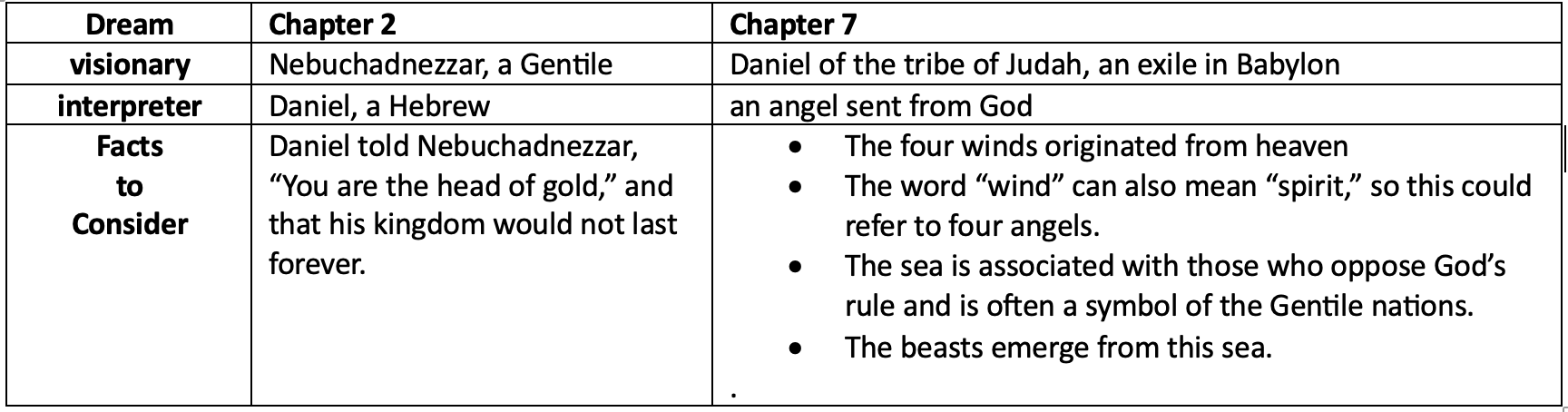
1. The answer to why these four kingdoms are represented by metals and later as beasts is that God wishes to contrast the human-ruler perspective and His divine-ruler perspective.
How does chapter 2 expose Nebuchadnezzar’s human perspective of kingdoms? Consider the symbolism of metals.
What does chapter 7 rightly affirm about God’s perspective regarding kings and kingdoms? Consider the symbolism of beasts.
You likely explained that God sees any king opposing His rule as a beast –– inhuman, unnatural, ugly –– so that explains why the beasts emerge from the sea. But they are not beasts are they? For Daniel 7:17 states they are kings. They are men. Let’s process that origin and God’s purpose for humanity. Regarding the creation of Adam, Genesis 2:7 states, “Then the LORD God formed the man of dust from the ground and breathed into his nostrils the breath of life and the man became a living creature.” Reflect on this to understand why Daniel later states these beasts arise from the earth (7:17).
2. What do these two origins (sea|earth) say about how man and woman have fallen away from God’s purpose?
No other living being is created with such intimacy as Adam. The LORD God did not simply speak him into existence as He does the animal: He formed Adam from dust and then breathed into his nostrils the breath of life. No other living creature is created in the image of God and given dominion over all the other living creatures (Genesis 1:26-27). No other living creature is commanded to multiply the image of God on the earth (Genesis 1:28). Reflect on this.
3. Comfort & Hope
What are God’s purposes for creating humanity? Consider the notes above this question.
Read Daniel 7:11–12; 15–18 again. How does God comfort those whose faith is in Him that He will fulfill these purposes?
Day 5 Father, open my eyes to see the truth in Your Word that I may know and love you more deeply.
Historical Context -- Significantly, chapters 2–7 of Daniel are written in Aramaic. Let’s review what we have read so far to determine why: In chapter two, Nebuchadnezzar has a dream about a great image of which he is the golden head, but a great stone topples this image and grows into an eternal kingdom. In chapter three, Nebuchadnezzar sets up his own great image, entirely of gold, and demands all to bow before it. Three Hebrews refuse and are delivered and vindicated. In chapter four, King Nebuchadnezzar acts proudly before the Hebrew God who humbles him; he repents and God returns his dominion. In chapter five, King Belshazzar also acts proudly before God; however, that very night he is found wanting and the empire of Babylon is taken by the Medes-Persians. In chapter six, Daniel refuses to obey the command of the king because he must obey the King of heaven. He is delivered from the lions and vindicated.
1. Imagine you are a Gentile living in ancient times and are able to read Daniel chapters 2–6 in Aramaic. How might the God of heaven use these stories, which were written in your native language, to stir your mind and heart for Him?
2. Now you, a Gentile whose tongue is Aramaic, come to chapter 7, also written in Aramaic, but not a narrative. You are clever enough to see that chapter 7 beasts parallel chapter 2 metals (gold = lion-eagle, silver = bear, bronze = winged leopard). The symbolic use of hybrid creatures is scary yet familiar to you, for you see hybrid creatures in the artwork and religion of your culture. Reading that the sea birthed violent beasts is also scary yet familiar to you. It reminds you of the creation story your mother told you at bedtime that went something like this:
Once upon a time, our mother goddess Tiamat, whose name means “Sea,” was angry with our father god Apsu. He wanted to destroy their children, Enlil and Ea, because they were just too noisy! Though she was angry, she said nothing to Apsu. However, one day Ea learned that his father wanted to kill him. So he killed Apsu before he could do that. This made Tiamat very angry with Ea! So she turned all her sea power on her children. They were powerless before her anger! But finally, Marduk, her grandson, said “I will defeat grandmother.” And he did. Then something strange happened. From Tiamat’s body emerged all of creation: the sun and stars, the waters and mountains, the trees, the lions, and you and me!. Today Tiamat lives on in the sea. She is still enraged and keeps trying to destroy all creation, even you and me. But Marduk, who became the chief god, sets up boundaries so she cannot.*
As a Gentile who read Daniel 1–6 and now this portion in chapter 7... how do you see that the God of heaven is different from the gods of your people?
*This is a simple retelling of the Enuma Elish, the Babylonian story of creation.
3. Welcome back to being a follower of Christ in the twenty-first century! Why do you think God would give Daniel a vision that featured hybrid beasts and the sea, characters Near Eastern Gentiles worshiped?
Consider the questions below to get to that answer.
How might the use of familiar Near Eastern symbols instruct Gentiles see-king to know the God of heaven?
How might the use of these symbols instruct the Hebrew people living under the rule of the Gentiles about how they should live as those called to be a witness to the Gentiles?
CHRISTOLOGICAL & APPLICATION
Historical Context -– We have learned that apocalypse means “unveiling” or “revelation.” Jesus is the ultimate apocalypse of God (Matthew 11:25–27): His divinity was hidden or “veiled,” but any Jew and Gentile see-king THE King saw He imaged God as no mere man could do (John 20:28; Mark 15:39) because Jesus submitted perfectly to the rule of the God of heaven. And...because He submitted perfectly, He also imaged perfectly what it means to be fully human.
1. Becoming fully human is our upward call (Philippians 3:14). Where have you found freedom and joy in releasing your own ideas about how to rule your life and submitting to the King of heaven?
2. What is an area in your life right now where you have come to the end of yourself and are just so ready to give it over to God?
Come to me, all who labor and are heavy laden, and I will give you rest. 29 Take my yoke upon you, and learn from me, for I am gentle and lowly in heart, and you will find rest for your souls.30 For my yoke is easy, and my burden is light.” Matthew 11:28–30
3. We are going to practice the Praying Together style we learned last week. First divide into duos or trios. Each person will pray through Matthew 11:28–30 to seek the comfort of Christ and surrender to His rule. Below is a prayer you can read if you wish to use this aid. While one prays, the other will pray with them silently and even out loud when they conclude. When you finish, together pray for the September Prayer Requests for the Church.
I come to you, Jesus. I no longer want to rule _____________ in my life. I have labored by ___________ and I am heavy laden. Give me your rest. I want to learn to surrender to the Father as You did. I want to learn to be gentle and humble as You are. Give me your yoke. Help me to depend entirely upon You and not on my own efforts.
September Prayer Requests for the Church
Our Spiritual Growth – Pray that God would grow our trust in His sovereign rule, asking for strength to stand firm in our faith so that we can live faithfully as we look forward to Christ’s everlasting kingdom.
Women’s Retreat Preparation & Sign-Ups – Pray that God would use this retreat to refresh women in their relationship with Him and with one another, renew their love and devotion to Christ, and awaken in them a deeper desire to serve in the church and city as an act of enduring worship.
The Persecuted Church – Pray that God would intervene for those imprisoned for their faith; ask for their release, and ask for comfort for their families who face emotional and economic hardship.’
God’s joy and strength to you,