
Week 25: The Fourth Beast
WEEK 25 | Daniel 7:7-8; 19-26, 28
Days 1-2 Father, open my eyes to see the truth in Your Word that I may know and love you more deeply.
After this I saw in the night visions, and behold, a fourth beast, terrifying and dreadful and exceedingly strong. It had great iron teeth; it devoured and broke in pieces and stamped what was left with its feet. It was different from all the beasts that were before it, and it had ten horns. 8 I considered the horns, and behold, there came up among them another horn, a little one, before which three of the first horns were plucked up by the roots. And behold, in this horn were eyes like the eyes of a man, and a mouth speaking great things. Daniel 7:7-8 ESV
OBSERVE DICTION
Ask: Which words/phrases might provide clues to the author’s message? What do they literally mean?
Ex. devour > In Daniel 3:8 and 6:24, this same word is translated as “maliciously accuse.”
Ex. broke in pieces> This word is used to describe how the stone crushed the iron|clay feet of the great image and to describe how the lions ate the bones of those who accused Daniel (2:34-35; 6:24).
Ex. horn > keren can be used throughout Scripture as a symbol of power when it relates to horns of certain animals.
Ex. eyes > Eyes can be symbolic of intelligence or insight.
OBSERVE FIGURATIVE DETAILS
Ask and answer simple w-questions: when? where? who? what? how?
1. The Setting (v7a)
With what words does Daniel transition to the fourth beast?
What time of day does he provide as context for when he received this vision?
2. The Fourth Beast (v7b-d)
What three adjectives does Daniel immediately list to describe this beast? (7b)
Does Daniel compare this beast to any beast familiar to him on earth (lion, bear, leopard)?
Of what metal are the beast’s teeth made? (7c) What does he do with his teeth?
What does he do with his feet?
When he compares this beast to the three that preceded it, what does Daniel say? (7d)
How many horns does this beast initially have?
3. The Little Horn (v8)
Where does the little horn emerge? Is this horn separate from the ten?
What does this little horn pluck up? How are they plucked?
What two things does this horn possess that you possess on your face?
What is it doing with its mouth?
INTERPRET
Ask: Why did the author choose to include these details and use these words?
1. Why do you think the fourth beast is not compared to any particular animal?
2. Little Horn
How is the little horn both inconspicuous* and yet conspicuous? Consider its “horn” compared to its “mouth.”
*inconspicuous – not readily noticeable
How might being both inconspicuous and yet conspicuous add to its military prowess*?
*prowess – superior strength/skill
3. Many scholars see this Fourth Beast as beginning with the Roman Empire but then transitioning from this historical empire to various stages that in the future will culminate in the Tribulation. What evidence do you see so far that might support the idea of “stages” of the Fourth Beast?
Days 3-4- Father, open my eyes to see the truth in Your Word that I may know and love you more deeply.
“Then I desired to know the truth about the fourth beast, which was different from all the rest, exceedingly terrifying, with its teeth of iron and claws of bronze, and which devoured and broke in pieces and stamped what was left with its feet, 20 and about the ten horns that were on its head, and the other horn that came up and before which three of them fell, the horn that had eyes and a mouth that spoke great things, and that seemed greater than its companions. 21 As I looked, this horn made war with the saints and prevailed over them,22 until the Ancient of Days came, and judgment was given for the saints of the Most High, and the time came when the saints possessed the kingdom.
23 “Thus he said: ‘As for the fourth beast, there shall be a fourth kingdom on earth, which shall be different from all the kingdoms, and it shall devour the whole earth, and trample it down, and break it to pieces. 24 As for the ten horns, out of this kingdom ten kings shall arise, and another shall arise after them; he shall be different from the former ones, and shall put down three kings.25 He shall speak words against the Most High, and shall wear out the saints of the Most High, and shall think to change the times and the law; and they shall be given into his hand for a time, times, and half a time. 26 But the court shall sit in judgment, and his dominion shall be taken away, to be consumed and destroyed to the end. Daniel 7:19-26 ESV
OBSERVE DICTION
Ask: Which words/phrases might provide clues to the author’s message? What do they literally mean?
Ex. fell > This is not “fall” as to fall at the little horn’s feet, but fall by violence (BDB 1103a2)
Ex. the times and the law> This is translated by the NET as “times set by decree,” but it is also possible that these two words word together refer to appointed times of religious festivals or practices.
Ex. time, times, and half a time > time = one year, times = two years, half a time = half a year. (cf. Dan 4:16, 23, 25, 32). 1+2 +.5 = 3.5 years. This time period correlates to the “great tribulation” (cf. Matt 24:15-22; Rev 7:14).
OBSERVE FIGURATIVE DETAILS
Ask and answer simple w-questions: when? where? who? what? how?
1. Review (vv15-18
Read these verses that we examined in our last lesson on the first three beasts. Write down any observations you want to keep in mind as we now study this fourth beast.
2. Revisiting the Fourth Beast (vv19-26)
Sum up the overlying reason why Daniel wants to know more about the fourth beast? (vv19-20)
What two additional details does he add about the fourth beast in verses 19-20?
If the three are referred to as the little horn’s “companions,” then are he and these three kings all known to one another and living as contemporaries?
Daniel provides information new to the reader that he had seen in his vision.
With whom does the fourth beast make war? (v21) Does he prevail over them?
Who comes and judges the fourth beast on behalf of the saints? (v22)
To whom do these saints belong?
What is given to the saints in time?
3. The Angel Foretells the Fourth Beast’s Rule and Destruction (vv23-26)
How much of the earth shall the fourth beast devour and trample down and break into pieces? (v23)
In which kingdom do the fourth beast and the ten horns/kings and an eleventh horn/king arise? (v23-24)
Who comes first the ten kings or the little horn/king?
What shall the little horn do to these ten kings?
Against whom shall this beast speak? (v25) Whom shall he wear out?
What does he think to change?
The “they” is a pronoun. This pronoun is separated a bit farther than normal from its specific noun referent (antecedent). The last noun that refers to people is “saints,” which is plural just as they is.
All that to say... who, then shall be given into this fourth beast’s hand? For how long?
We started Daniel with the Lord giving Judah into the hands of a Gentile king. This began the Age of the Gentiles. List the four steps delineated in verse 26 that describes how the Lord will bring the Age of the Gentiles to an end.
o
o
o
o
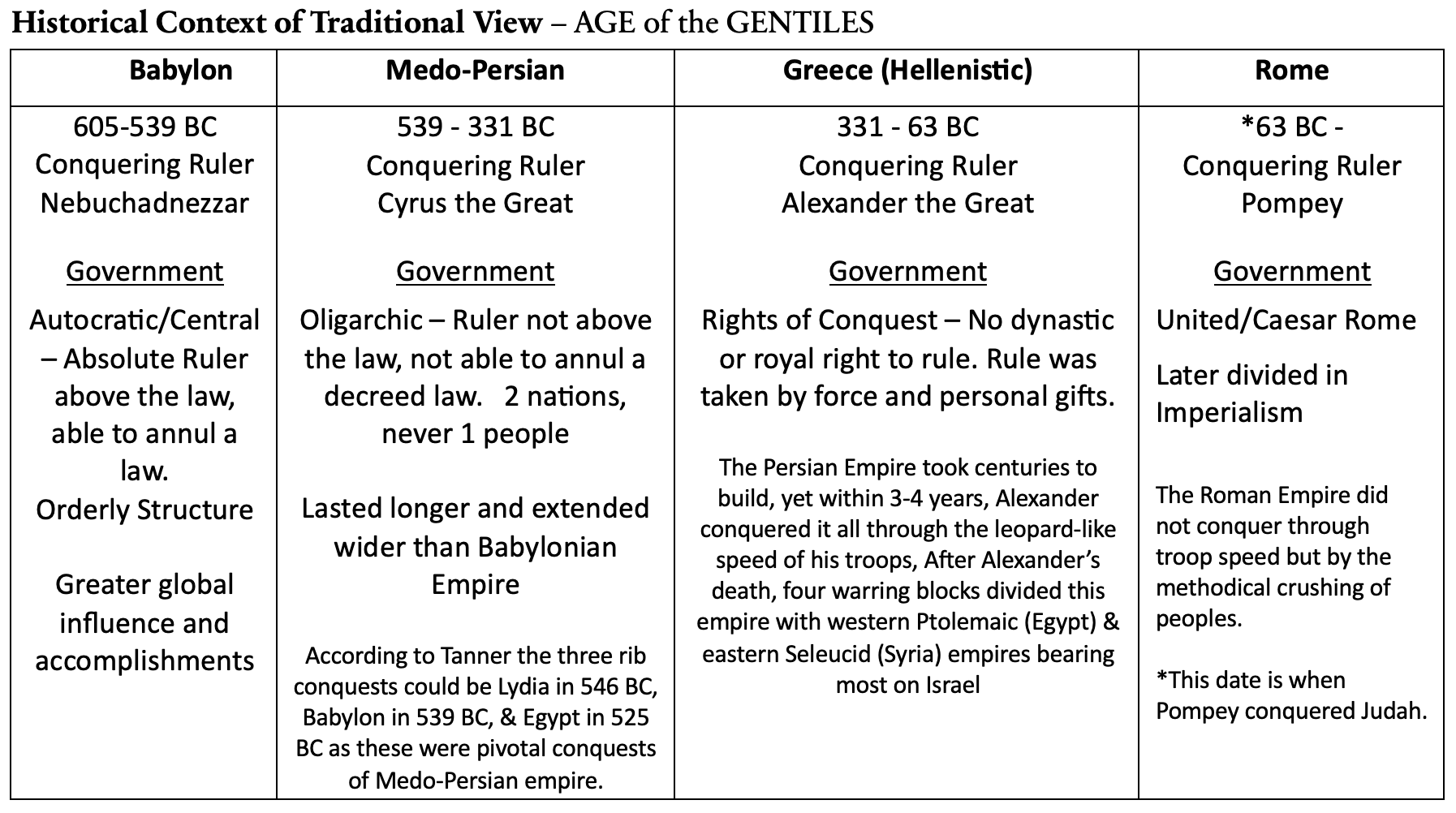
Beast #4 Historical Background – According to Tanner, conservative evangelical scholars are “virtually unanimous” in identifying Rome as the fourth kingdom (411). Rome’s empire began in 241 BC and began to wane after its height in AD 117. When Pompey defeated Syria and Palestine, in 64/63 BC, Israel was subjugated to Rome. Jesus lived and ministered under Roman rule and He was crucified by Pontius Pilate, a Roman governor. In AD 70, Jerusalem was destroyed by the Romans. The book of Revelation also falls under apocalyptic genre; it both affirms and expands upon some of the revelation given to Daniel. In this book, the apostle John is given visions of what will happen in the distant future. Of its twenty-two chapters, roughly thirteen (6-19) cover the tribulation, and the fourth beast with its ten horns and little horn are featured in chapters 13, 17, and 19.
What does this tell us? If the fourth kingdom is Rome and that empire began to wane after AD 117, then somehow the character of the Roman empire endures and is ruling during the tribulation. Note that Daniel 7:24 states that the horns shall arise out of the fourth kingdom. This means that this fourth kingdom is somehow in operation over an extensive period of time, yet Rome does lose its empire status historically. It’s evident, therefore, that there is a “gap” between the historical rule we know and how this fourth kingdom shall rear its head again during the tribulation. In Revelation it appears that even the characteristics of the first three beasts are present in the fourth: “And I saw a beast rising out of the sea, with ten horns and seven heads, with ten diadems on its horns and blasphemous names on its heads. And the beast that I saw was like a leopard; its feet were like a bear’s, and its mouth was like a lion’s mouth. And to it the dragon gave his power and his throne and great authority (13:1-2).
INTERPRET
Ask: Why did the author choose to include these details and use these words?
1a. –– Read cross–references to Daniel 7:21-22 in Revelation and write just a gist.
Revelation 13:7
Revelation 13:8, 15 (c.f. 14:9-12)
Revelation 19:20
Revelation 20:4-6
Matthew 24:13
1b. According to Daniel 7:21-22, the little horn prevails over the saints in the tribulation, yet the saints possess the kingdom. Using your timeline in 1a and these verses, explain how this is possible in light of the historical Jesus the Messiah.
2a. Daniel 7:24 and tribulation timeline cross reference in Revelation. Read each reference and write just a gist.
Revelation 13:2b (The dragon refers to Satan.)
Revelation 17:13
Revelation 17:16-17
2b. Given what you read in Revelation regarding the little horn and the ten horns/kings, how is it possible that the little horn subdues the ten? Consider what you can also conjecture as the possible scenario.
3a. We read that the little horn speaks words against the Most High and that he wears out the saints (v25). This summarizes his actions against God and the saints (set apart people for God) during the “great tribulation,” which is the second half of the tribulation. According to our diction box, how he changes the times and law can refer to religious worship. You read that the little horn, also known as the Antichrist, receives his power from Satan himself.
What is Satan’s purpose? What do imagine will happen during the second half of the tribulation?
3b. What evidence do you see in the text of this lesson that God is in control?
Day 5 Father, open my eyes to see the truth in Your Word that I may know and love you more deeply.
Here is the end of the matter. As for me, Daniel, my thoughts greatly alarmed me, and my color changed, but I kept the matter in my heart.” Daniel 7:28 ESV
1. What is understandable to you about Daniel’s response regarding the future trial for his people? Note Daniel was not commanded to go immediately to verbally tell others. He was only told to record the dream and visions.
2. Christians have different beliefs about how God exactly will be in control during the tribulation and millennial kingdom. Some flippantly say, “I’m not amillennial, postmillennial, or premillennial. I am pan–millennial.”
I recently heard of this pan–millennial stance and was told “A pan–millennial believes it will all pan out in the end.” Or to couch that in Laredo verbiage, “No pasa nada.”
This is an application question: Why is it honoring to God to read apocalyptic passages such as those in Daniel 7 and in Revelation?
3. These texts challenge our minds and hearts and strength to grow as believers even in this time.
How does studying end-times texts grow us personally as disciples living in Laredo now? Share how God is growing you in this.
How does it prepare us to make disciples of all generations in Laredo now? Think of one person in your life who needs to hear that Satan is seeking destructive rule, but the Prince of Peace will defeat him.
Let’s pray! –– Turn your responses to #3 above into prayers for our people and city: “Your kingdom come, Lord. Your will be done.”
Praying Together
Foundation: Throughout the New Testament, we see believers praying together. They “joined together constantly in prayer” (Acts 1:14), “devoted themselves…to prayer” (Acts 2:42), and “raised their voices together to God” (Acts 4:24). Prayer was not simply something they listened to others do – it was something they participated in together.
Have you considered:
When someone else is praying, are you simply listening to their prayer or are you joining them in prayer?
Prayer: Conversation with God
Community Prayer: God’s people intentionally seeking and speaking to God together, with multiple members contributing to the conversation with God
Agreement: Joining your heart with what another person is praying, and internally echoing that prayer to God
September Prayer Requests for the Church
Our Spiritual Growth – Pray that God would grow our trust in His sovereign rule, asking for strength to stand firm in our faith so that we can live faithfully as we look forward to Christ’s everlasting kingdom.
Women’s Retreat Preparation & Sign-Ups – Pray that God would use this retreat to refresh women in their relationship with Him and with one another, renew their love and devotion to Christ, and awaken in them a deeper desire to serve in the church and city as an act of enduring worship.
The Persecuted Church – Pray that God would intervene for those imprisoned for their faith; ask for their release, and ask for comfort for their families who face emotional and economic hardship.’
God’s joy and strength to you,